The literature from the early 20’th century on the parallel development of the “wire and radio art” makes for fascinating reading today. In this note, we will look at some excerpts from this article:
A. A. Oswald, “Early History of Single-Sideband Transmission,” in Proceedings of the IRE, vol. 44, no. 12, pp. 1676-1679, Dec. 1956, doi: 10.1109/JRPROC.1956.275033.
Consider specifically this remarkable paragraph:
The first step was the recognition of sidebands per se. Until well after Carson’s invention, there seems to have been no general, clear-cut recognition outside the Bell System, that modulation of a carrier by voice waves results in side frequencies above and below the carrier. LeBlanc, in describing his multiplex system,3 speaks of the modified high-frequency wave and calls for a channel spacing “high compared with the pitch of the sound waves.” This might be construed as implying that a transmission band is involved but LeBlanc makes no comments in this direction. Fleming4 treats the modulated carrier as a wave of constant frequency but varying amplitude. Stones as late as 1912 says, “There is, in fact, in the transmission of a given message, (by carrier) but a single frequency of current involved.”
The phrase “recognition of sidebands” sounds strange to a modern reader. What does it mean to fail to recognize sidebands? The last sentence is easier to understand: a high frequency carrier remains very nearly a pure sine-wave when modulated by varying its amplitude in sympathy with a slowly-changing voice waveform. The frequency spread of such a modulated signal should not be significantly different from that of a single-frequency sine-wave.
This is a true and fairly trivial observation. In modern language, we would say the Fourier transform of a gently modulated carrier wave i.e. “a narrowband signal” looks approximately like a Dirac delta function at the carrier frequency!
Enter now a “multiplex system” i.e. a comms link over which supports multiple simultaneous transmissions. Now it becomes necessary to quantify, at least crudely, the frequency spread of each transmission e.g. the simple heuristic: channel spacing “high compared with the pitch of the sound waves.”
When the multiplex systems start to scale up, and the frequency spacing becomes smaller, we eventually get to a place where the “bandwidth” of the modulated carrier needs to be specified more precisely. This eventually leads to the discovery of the existence of two sidebands and their redundancy, using both experimental and mathematical methods. Hence “recognition of sidebands”!
As a final note, the “high frequencies” involved in these early carrier systems were at frequencies far lower than what we described in an earlier note as the “prime beachfront real-estate” of the wireless spectrum! 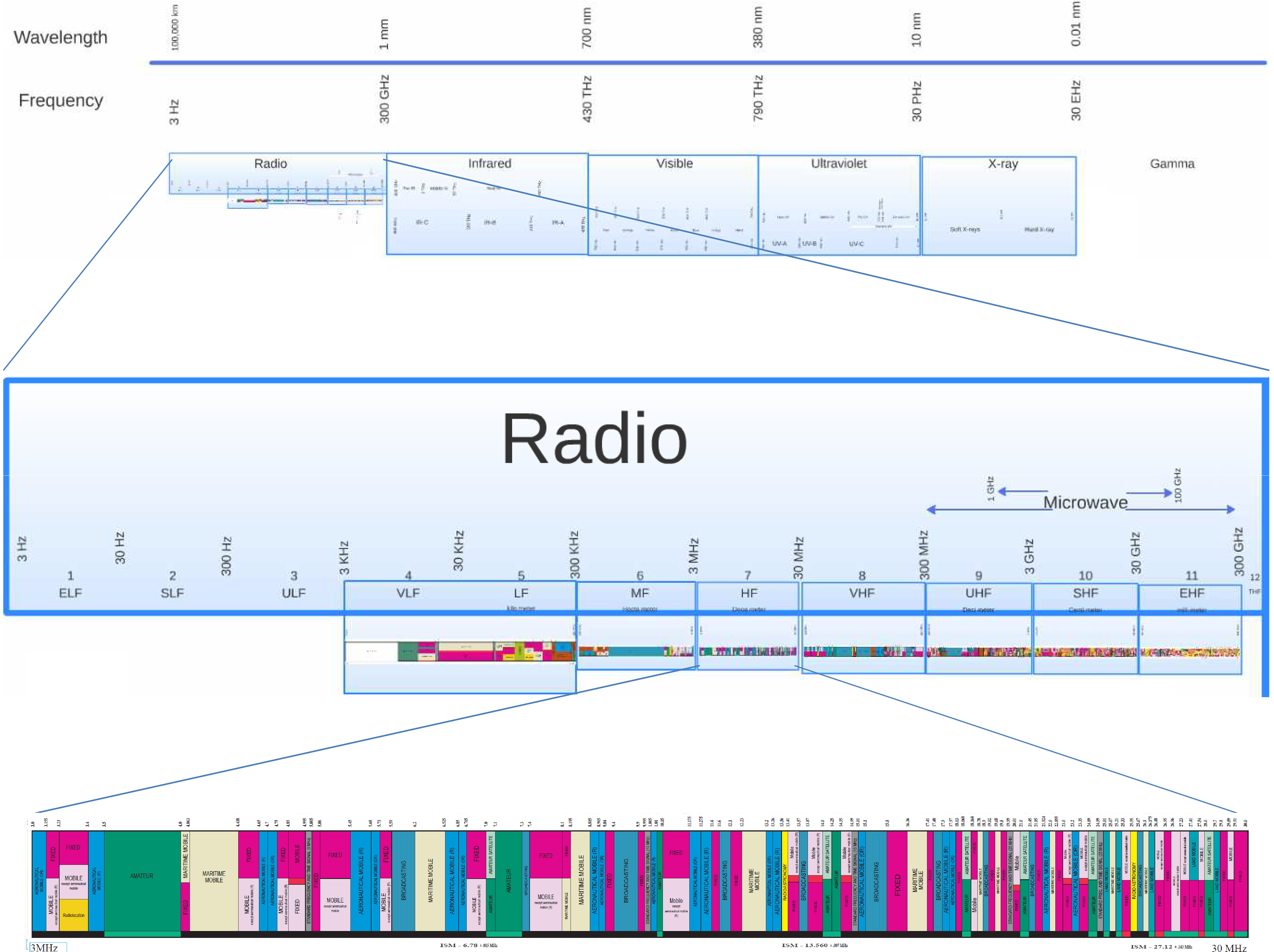 from https://en.wikipedia.org/wiki/High_frequency
The names for the various frequency bands as they started to be used is itself a fascinating story for another day.
 hawkee